Saturday, October 23, 2010
The value of debate
It seems my last post has caused some debate. You can check it out below in the comments section for the starlight post, and here on the climbing website Mountain Project (scroll all the way down). Feel free to add your voice!

Saturday, October 16, 2010
Starlight Video
So last week, as you might have read below, I was working on a route called Starlight at Thunder Ridge. Though the route is fully bolted, and I had tried it once on bolts back in the spring, I was working it thin time just on gear.
I was on the second lead attempt of the morning, I was in the process of melting down. I had reached the pre-crux stance, but was unable to relax. I was pumping out, sweating, and worriedly looking back at my last stopper.
At this exact moment, our friends round the canyon and are welcomed by the sight of me, out on lead, freaking out and shaking. Lisa prudently puts her camera on video mode.
I can see a trucker placement right in front of me, and succeed in placing the correct stopper. That's when the pump clock, expires, though, and I don't even have time to clip the newly placed stopper:
I was on the second lead attempt of the morning, I was in the process of melting down. I had reached the pre-crux stance, but was unable to relax. I was pumping out, sweating, and worriedly looking back at my last stopper.
At this exact moment, our friends round the canyon and are welcomed by the sight of me, out on lead, freaking out and shaking. Lisa prudently puts her camera on video mode.
I can see a trucker placement right in front of me, and succeed in placing the correct stopper. That's when the pump clock, expires, though, and I don't even have time to clip the newly placed stopper:
Here's some more video that Lisa shot of the crux lunge to the mysterious "Manta Ray" flake, then continuing up the route:
A few days later, I came back and sent the line placing all gear on lead.
Thanks to Lisa for the video, and for burning it to a cd and dropping it off at my house! You Rock!
Thursday, October 14, 2010
Starlight
-or-
How to preserve the future of Colo-RADNESS
Here in Colorado, and across the West, hard sport routes are as common as crag dogs at Indian Creek. You can go crank, crimp, jug-haul, dyno, spray, and clip bolts to your hearts content at crags like Boulder Canyon, the Flatirons, Industrial Wall, Shelf Road, Clear Creek, Devil's Head, the Monastery, the Fortress, Rifle...
Hard traditional route are definitely a rarer breed. This is partially because more climbers are attracted to the convenience and low cost-of-entry of sport climbing, and also due to the nature of the routes themselves.
Most difficult bolt-less lines tend to be either scary run-out face climbs or burly (often painful) crack climbs, either way rarely traveled.
Most difficult bolt-less lines tend to be either scary run-out face climbs or burly (often painful) crack climbs, either way rarely traveled.
 |
| Do YOU bolt cracks? Garrett Grove Photo |
It is a shame, then, that one route with potential to be a mega-classic, 5.12 trad pitch was fully bolted.
Thunder Ridge, an amazingly unique granite crag in Colorado's South Platte region, is supposedly a trad bastion, with mixed routes, sometimes run-out face climbs, and ground-up FAs. One of the most compelling walls at T-Ridge is the "Wild Overhang" or "Gaston Rebuffat" wall. (Rebuffat was a badass French alpinist, climbing innovator, and author of "Starlight and Storm").
 |
| Garrett Grove Photo |
This sweep of overhanging rock would dominate any climbers dreams, with it's gorgeous, plated face. Right up the middle, there's a line of discontinuous cracks and jugs, culminating with a blank section. Luckily, a mysteriously solid flake levitates in the middle of the blank stretch, linking you to another juggy overhang. Starlight is an improbable and challenging line, and one that miraculously has bomber gear placements the entire way! Unfortunately, a little over ten years ago, it was entirely bolted, with bolts sometimes inches from textbook stopper placements.
 |
| Garrett Grove Photo |
I wasn't the first one to notice the trad potential of the route, but even still, when I first tried it I clipped the bolts. Once I saw first-hand how solid the protection would be, though, I started working it on gear. Multiple whippers tested various placements, as I hung from the relentless overhang and tried to find the correct stoppers to slot in the bottle-neck placements. Once in, though, every placement is indestructible!
 |
| Going for the ride after pumping out, trying to place, and then clip, the next stopper. Garrett Grove Photo |
 |
| Once I placed everything, the pre-crux "Life Station" was better than many belays I've built! |
This past Monday, on my first burn of the day, fifth attempt overall, I sent the route, clipping no bolts (including the anchors). I climbed to the top of the dome (still with great pro: slung chicken-heads!), and then down-climbed to the huge sling anchor atop the steep section.


 |
| The crux sequence: Establish on tiny footholds, Lunge for the "Manta-Ray" flake, and then move past to some giant jugs (and a rock-solid cam!). Garrett Grove Photos. |
Now someone needs to improve on my style and establish a real "traditional" route by entirely shunning the bolts and working it ground up on gear.
 |
| Dreaming of the Send. Garrett Grove Photo |
 |
| The rack. |
In order to preserve our limited rock resources here in Colorado, and elsewhere in the heavily climbed West, I think we need to appreciate potential future trad climbs. Regardless of difficulty, we need to recognize that if the gear is there, someone strong and motivated enough will eventually find the route and send it in good style. There is no need to bolt a line simply because the would-be first ascentionists think that they need to hang-dog up it and want the convenience of low-commitment sport climbing. By doing so, they are denying themselves and others the mental and physical challenge of a gear-protected masterpiece.
--------------------------------------------------------------------------------------------------------
Thunder Ridge Beta:
Thunder is a fantastic and unique collection of granite crags in Colorado's South Platte region. While you won't find massive vertical relief (nothing over a single pitch), you will find amazing features, including chicken-heads, "gator-skin", jugs, cracks, overhangs, roofs, slabs, and much more!
 |
| Blake climbing "Is This For Real!?!" Garrett Grove Photo |
Here's how to get there from Boulder, including a key shortcut not listed elsewhere:
Head south out of Boulder on Broadway (93)
Follow 93 through Golden, and then follow signs for 470 South (towards Colorado Springs)
Take 470 South to 285 South (towards Fairplay)
(the shortcut):
~14 miles after joining 285, find Foxton rd. You exit on the right hand side, and then turn left (going under 285) to follow Foxton Rd. South.
When Foxton Rd. reached the South Platte, turn right to follow the river upstream. The road here turns to gravel, but it's well-maintained and easy, and it cuts off a bunch of mileage and a huge hill from the alternative (following 285 to Pine Junction)
Follow the gravel road along the river through the tiny town of Foxton, and under the beautiful Cathedral Spires. The road eventually spits you out at Buffalo Creek, on CO Rd 126 aka Deckers Rd. Take a Left (South) and head towards Deckers.
After passing through Deckers, the road winds uphill. Keep your eye out on the right for signs to WestCreek. You'll first pass Westcreek Rd, you don't want that. Very soon, though, take a right onto Abbey Rd. (there's a sign for Westcreek).
Abbey Rd. winds quickly down into Westcreek, take a left on the main road. Follow it for a few hundred yards, and then take a right on Stump Rd (just before the Fire House).
Follow Stump road past a large dome on your right (the Sheep's Nose). Shortly after passing the Nose, take a right on Road 9J.
There are a few minor roads that branch off of 9J, but stay straight on the main road all the way to it's end (at the arch that says "Rancho Cisneros"). It ends at a gate (that may or may not be closed) clearly marked as private. DO NOT DRIVE PAST THIS GATE. Park here, making sure not to block the gate.
 |
| This is where you park. Hike through the (sometimes closed) gate on the left. The crags are visible on the right. |
Now you're actually heading towards the crags, and the trail is easy to follow. It drops down and crosses a small drainage, and then enters an aspen forest shortly before reaching the first crag.
The first rock you encounter will be some SW facing slabs, this is the Quarry wall. Around on the SE aspect of the same rock, you'll find the "For Real" Wall. Continuing East past the entrance to For Real canyon brings you to Wasp Canyon. Heading up Wasp Canyon brings you to the South Facing Brown Wall.
From Boulder, the drive takes ~1.5 hours, and the hike ~30 minutes. The crag is well worth it!
More Thunder Ridge Beta:
Season: Anytime, although mid-summer can be scorching hot, and mid-winter can be snowy (duh). Spring and Fall are perfect. The crags face all different directions, and it's easy to chase the sun or shade depending on what you need. The Wild Overhang Wall (with Starlight) faces East, and gets brief morning sun.
Camping: not totally sure. I don't recommend camping at the trailhead, as there's a big sign telling you not to, and the land-owners drive by fairly often. I do think it's fine to camp at the crags, but I'm not clear on the land management there. Anyone know?
There's also good camping back towards Turkey Rocks. To get there, drive back down Road 9J to Stump rd, and then take a right. Where Stump trends left, continue on another dirt road (FR 51/360). On the way to Turkey Rocks, you'll pass camping on your left, and eventually reach some great spots near the trailhead.
Water: There's a pretty tasty spring up Wasp Canyon, just below the climb "Powder Monkey"
Rack: Bring your full trad arsenal, as well as 12-16 quickdraws. Cams up to 4" and extra passive pro (all sizes, RPs to small hexes) will be essential. A single 60m rope seems to have worked on all of the climbs I've done.
Guidebooks: None currently out. MountainProject is a pretty good source, though. Many of the FAs and developers have posted their routes.
Classics (that I've done, I'm sure there are many more!):
Is This For Real?!, 5.10, trad
Reptile Tears, 5.10, trad
Powder Monkey, 5.11-, trad
Everything on the "Gaston Rebuffat" wall (The steep wall in Wasp Canyon)
-Scorpions, 12a, Sport
-Storm, 12b, Sport
-The G Route, 12, Sport
-Starlight, 12, TRAD!
 |
| Blake (I think?) on "The G-Route". "Powder Monkey" is the Twin Crack system on the left side of the cliff across the canyon. Garrett Grove Photo |
Climb Safe!
Sunday, October 3, 2010
ASTRODOG
Black Canyon pt.2
In my ongoing quest to climb every "Astro" route in the country, Blake and I journey back to the Black Canyon of the Gunnison:
Astro-Dog from Scott Bennett on Vimeo.
Historical Note:
The "Astro" naming theme originated in 1975 with John Long, John Bachar, and Ron Kauk when they freed Warren Harding's "East Face of Washington's Column", re-naming the paradigm-shifting climb after a Hendrix tune.
In homage to Astro-Man, others around the West have used the Astro prefix on many climbs, usually long, stellar, 5.11 crack climbs.
Astro routes I've ticked so far:
Astro-Man, Yosemite, CA
Astro-Hulk, Incredible Hulk, CA Sierra
Astro-Turkey, Sunshine Wall, South Platte CO
Astro-Dog, Black Canyon, CO
To Do:
Astro-Elephant, Elephant's Perch, ID
Astro-Yam, Yamnuska, WA
Astro-Monkey, Smith Rock, OR
Astro-Glide, Devil's Tower, WY
Anyone know more?
In my ongoing quest to climb every "Astro" route in the country, Blake and I journey back to the Black Canyon of the Gunnison:
Astro-Dog from Scott Bennett on Vimeo.
Historical Note:
The "Astro" naming theme originated in 1975 with John Long, John Bachar, and Ron Kauk when they freed Warren Harding's "East Face of Washington's Column", re-naming the paradigm-shifting climb after a Hendrix tune.
In homage to Astro-Man, others around the West have used the Astro prefix on many climbs, usually long, stellar, 5.11 crack climbs.
Astro routes I've ticked so far:
Astro-Man, Yosemite, CA
Astro-Hulk, Incredible Hulk, CA Sierra
Astro-Turkey, Sunshine Wall, South Platte CO
Astro-Dog, Black Canyon, CO
To Do:
Astro-Elephant, Elephant's Perch, ID
Astro-Yam, Yamnuska, WA
Astro-Monkey, Smith Rock, OR
Astro-Glide, Devil's Tower, WY
Anyone know more?
Friday, October 1, 2010
Out of the Blue
-and into THE BLACK-
Black Canyon trip report, part one
The Black Canyon of the Gunnison is home to the biggest vertical rock walls on the state of Colorado. The fact that I had never climbed there seemed to be a grave oversight. One that had to be remedied.
Blake Herrington would help me remedy it.
Two weeks ago, after four+ hours of in-the-dark, twisty-mountain-road, eager-anticipation driving, we arrived at the North Rim of the Black Canyon. There was nothing visible at night that would indicate the massive vertical relief, literally a hundred yards from where we would set up camp, just the uniform high desert plains of Western Colorado.
Even in the morning, making coffee and sorting the rack in our campsite, I was confused as to where the canyon was supposed to be. Luckily Blake had been here before, and knew where to find the canyon.
After making the short walk over to the ranger station to sign in and declare our route (now we're committed!), we found the start of the Cruise gully and began to descend. 2 rappels, much poison-ivy avoidance, and 1500 vertical feet later, we were at the base of the day's objective: the Dylan Wall.
Dylan Wall starts up one of the most well-defined route on the North Chasm view wall, the Scenic Cruise. After just a few pitches, though, it leaves the perfect, clean hand crack and embarks on a diagonaling course up and right, following an obvious, but slightly chossy crack system. Blake led the first two pitches of Dylan, including a slightly scary overhanging choss band, and set me up below the crux. And I mean, 10' below the crux, with no obvious gear between his belay and the not-too-inspiring fixed pin at the crux.
I lead off the belay, vainly searching for gear, but get just one tiny RP before clipping the crucial piton, which sticks out of the crack at a disturbing angle. I pull into the small roof/corner system, find all the holds I need, but refuse to commit off the questionable gear. I hang on the pin, reach high to get a bomber piece, and then lower back to fire the tricky sequence.
By now, though, there's another thought at the forefront of our minds, besides awe for the size of the canyon, fear of the sometimes scary rock, and anticipation for the many hard pitches waiting above. The new factor that is consuming our thoughts is the overwhelming heat! The sun is now fully on us, and we are baking on the exposed wall. Dylan Wall joins Journey Home (a much easier 5.9) halfway up, and we had intended to break off left to finish with Twisted, which would include much more hard climbing. When we reach Journey Home, however, the heat is too oppressive to consider anything other than the fastest possible escape. Racing up Journey Home, we reach the canyon rim, and are soon back in the shade of our campsite, drinking cold beer and enjoying music and food. How quickly things change!
The next morning, we leave camp with a plan. We now know our greatest enemy: the Sun! So we start on the Checkerboard wall, which faces South-West. It will hold a few hours of morning shade, hopefully enough to let us navigate its tricky 5.10+ cruxes and runouts.
Checkerboard wall goes well, with Blake styling the heads-up crux lead, and me sketching my way up the final runout slab just as the comes into the sun. We improvise a gully descent with a few easy rappels back down into the depths of the canyon, and make a run for the river! Reaching the beautiful Gunnison river in the heat of the day is refreshing, but even still its a bit too cold for prolonged swimming. We each take a quick dip, and then relax on the shore, eating lunch and refilling water.
So now it's 1pm, we're lounging at the bottom of a 2000' canyon, and we have no intention of hiking back out that poison-ivy choked gully. No, we'll simply wait until the sun leaves the wall, and then scurry up the Scenic Cruise.
2:30 comes and goes, and the wall still looks as hot as black pavement in the desert. By 2:45, we feel we can't wait any longer, so we start up the lower easy pitches. I take the lead, and Blake simuls behind, linking the first fours pitches. I aim for a shallow right facing corner, thankfully with some shade, to set my belay. By the time Blake reaches my belay and I set out on the next lead, the wall has mercifully gone into shade, and I continue up the sustained, gorgeous 5.10 cracks. I learn to avoid the darker colored holds, as they are the warmest.
After two more pitches, now through the 5.10+ crux, Blake takes the sharp end and leads up out the wandering top pitches. He leads in fine style, with an emphasis on speed, as between us we only have one mini-headlamp, more suitable for a keychain than a Grade V climb.
Just as the sky is finishing its daily journey from blue-to orange-to red-to purple, we pull over the rim and onto the fenced off tourist overlook. Another day of climbing is over, and another round of beer, music and food at the campsite begins.
Day three, and we're looking for maybe a shorter objective, and of course something in the shade. We hike over to the SOB gully, and down to Comic Relief. This classic climb features a number of harder variations, and we enjoy all of them, including an amazing 5.11+ finger crack/corner. We bring my ipod and speakers, and enjoy plentiful tune-age all the way up the climb. Topping out midday, we have enough time to enjoy sandwiches and cold drinks at camp before packing up for the drive home.
My first visit to the Black was so much fun, we planned another trip, two weeks later. Check back here for part two of the Black Canyon report, when we revisit an even hotter Black Canyon, but this time on the South (shadier) side of the canyon. Next up: Astro-Dog!
Also, check out Blake's account of the trip.
Black Canyon trip report, part one
The Black Canyon of the Gunnison is home to the biggest vertical rock walls on the state of Colorado. The fact that I had never climbed there seemed to be a grave oversight. One that had to be remedied.
Blake Herrington would help me remedy it.
Two weeks ago, after four+ hours of in-the-dark, twisty-mountain-road, eager-anticipation driving, we arrived at the North Rim of the Black Canyon. There was nothing visible at night that would indicate the massive vertical relief, literally a hundred yards from where we would set up camp, just the uniform high desert plains of Western Colorado.
 |
| Making breakfast in camp |
 |
| Found it! |
After making the short walk over to the ranger station to sign in and declare our route (now we're committed!), we found the start of the Cruise gully and began to descend. 2 rappels, much poison-ivy avoidance, and 1500 vertical feet later, we were at the base of the day's objective: the Dylan Wall.
Dylan Wall starts up one of the most well-defined route on the North Chasm view wall, the Scenic Cruise. After just a few pitches, though, it leaves the perfect, clean hand crack and embarks on a diagonaling course up and right, following an obvious, but slightly chossy crack system. Blake led the first two pitches of Dylan, including a slightly scary overhanging choss band, and set me up below the crux. And I mean, 10' below the crux, with no obvious gear between his belay and the not-too-inspiring fixed pin at the crux.
I lead off the belay, vainly searching for gear, but get just one tiny RP before clipping the crucial piton, which sticks out of the crack at a disturbing angle. I pull into the small roof/corner system, find all the holds I need, but refuse to commit off the questionable gear. I hang on the pin, reach high to get a bomber piece, and then lower back to fire the tricky sequence.
Leaving Scenic Cruise, the trade route, for Dylan Wall. Sorry for the poor video, it was shot with my ipod.
By now, though, there's another thought at the forefront of our minds, besides awe for the size of the canyon, fear of the sometimes scary rock, and anticipation for the many hard pitches waiting above. The new factor that is consuming our thoughts is the overwhelming heat! The sun is now fully on us, and we are baking on the exposed wall. Dylan Wall joins Journey Home (a much easier 5.9) halfway up, and we had intended to break off left to finish with Twisted, which would include much more hard climbing. When we reach Journey Home, however, the heat is too oppressive to consider anything other than the fastest possible escape. Racing up Journey Home, we reach the canyon rim, and are soon back in the shade of our campsite, drinking cold beer and enjoying music and food. How quickly things change!
Discussing heat, sandwiches, and what we should rename "Journey Home"
The next morning, we leave camp with a plan. We now know our greatest enemy: the Sun! So we start on the Checkerboard wall, which faces South-West. It will hold a few hours of morning shade, hopefully enough to let us navigate its tricky 5.10+ cruxes and runouts.
Checkerboard wall goes well, with Blake styling the heads-up crux lead, and me sketching my way up the final runout slab just as the comes into the sun. We improvise a gully descent with a few easy rappels back down into the depths of the canyon, and make a run for the river! Reaching the beautiful Gunnison river in the heat of the day is refreshing, but even still its a bit too cold for prolonged swimming. We each take a quick dip, and then relax on the shore, eating lunch and refilling water.
So now it's 1pm, we're lounging at the bottom of a 2000' canyon, and we have no intention of hiking back out that poison-ivy choked gully. No, we'll simply wait until the sun leaves the wall, and then scurry up the Scenic Cruise.
2:30 comes and goes, and the wall still looks as hot as black pavement in the desert. By 2:45, we feel we can't wait any longer, so we start up the lower easy pitches. I take the lead, and Blake simuls behind, linking the first fours pitches. I aim for a shallow right facing corner, thankfully with some shade, to set my belay. By the time Blake reaches my belay and I set out on the next lead, the wall has mercifully gone into shade, and I continue up the sustained, gorgeous 5.10 cracks. I learn to avoid the darker colored holds, as they are the warmest.
After two more pitches, now through the 5.10+ crux, Blake takes the sharp end and leads up out the wandering top pitches. He leads in fine style, with an emphasis on speed, as between us we only have one mini-headlamp, more suitable for a keychain than a Grade V climb.
 |
| Sunset in the Black |
Day three, and we're looking for maybe a shorter objective, and of course something in the shade. We hike over to the SOB gully, and down to Comic Relief. This classic climb features a number of harder variations, and we enjoy all of them, including an amazing 5.11+ finger crack/corner. We bring my ipod and speakers, and enjoy plentiful tune-age all the way up the climb. Topping out midday, we have enough time to enjoy sandwiches and cold drinks at camp before packing up for the drive home.
My first visit to the Black was so much fun, we planned another trip, two weeks later. Check back here for part two of the Black Canyon report, when we revisit an even hotter Black Canyon, but this time on the South (shadier) side of the canyon. Next up: Astro-Dog!
Also, check out Blake's account of the trip.
Friday, September 24, 2010
Nu Para Shooos
or, uh,
New Pair of Shoes
In the world of all-consuming hobbies/sports/obsessions, climbing is a pretty light one on the wallet. There's a pretty big startup cost; you have to outfit yourself with a pretty large array of gear. Once you've made that capital investment, though, there are few day-to-day cost to get out and rock climb. Most parks are free or very cheap (at $60/year, Eldorado canyon state park is one of the more expensive climbing venues, but that's still less than one lift ticket to a Colorado mountain).
If you buy good quality gear and take care of it, there's no reason why a set of cams, stoppers, biners, etc shouldn't last you 5-10 years. There are a few "consumables", though, and the big ones for climbers are ropes and shoes. With intense use, both can wear out in the span of a year or two.
So, climbers are ALWAYS psyched to check out new shoes. Having a fresh coating of sticky rubber on your toes does wonders for your climbing, letting you stick to holds you normally wouldn't trust. The new shoes smell alone is enough to have me reaching for my chalk bag and thinking about some intense edging testpiece (like Eldo's "Madame Guillotine").
So when the cool folks over at Climb X asked me if I'd like to check out a pair of their "Technician" climbing shoes, and I was very stoked!
Out of the box and onto my feet, it was unfortunately too late to run over to Eldo for a test run, so I did the next best thing and went to the basement for an indoor session. Our 10' bouldering wall doesn't really provide an actual climbing experience, but I could tell the shoes fit well.
Eldorado canyon, Thursday morning. I meet my good friend Zack in the parking lot, and the splitter day beckons with good temperatures and clear skies. We head up to try a new-ish bolted route, the Vaporizer. After a 300' 5.4 ramp approach, the climb achieves an airy position high over the canyon. Starting out with thin, off balance edging, and finishing with too-good-to-be-true jugs, this pitch certainly entertains. The shoes preformed well, sticking to the typical coin sized foot chips and slippery sloping rails.
As the sun rose higher in the sky, temperatures followed, and we soon were seeking shade. North Face of the Bastille is always a great option, with one of the world's shortest approaches.
My edging nemesis, Madame Guillotine, starts right off the ground and is a very convenient way to shred your fingertips! With cooler temps in the shade, though, I feel good on the micro-holds. No send this time, but I have all the moves. Just need to let my skin recover and give it another go!
We wrapped up the day with a fun link-up of Werk Supp->Nexus->Bastille Crack->Outer Space->XM->West Buttress. We didn't really do that many pitches, but we did climb a little terrain on all of those routes, making a massive rightwards traversing girdle of the Bastille. Still going strong, my feet hardly complain from all of the low-angle climbing. Topping out the Bastille at sunset, I change into flip-flops for the descent and hurry back to home, dinner, and beer.
What a great day outside!
New Pair of Shoes
In the world of all-consuming hobbies/sports/obsessions, climbing is a pretty light one on the wallet. There's a pretty big startup cost; you have to outfit yourself with a pretty large array of gear. Once you've made that capital investment, though, there are few day-to-day cost to get out and rock climb. Most parks are free or very cheap (at $60/year, Eldorado canyon state park is one of the more expensive climbing venues, but that's still less than one lift ticket to a Colorado mountain).
 |
| There's gold in them thar hills! Driving to the mythical Eldorado. |
If you buy good quality gear and take care of it, there's no reason why a set of cams, stoppers, biners, etc shouldn't last you 5-10 years. There are a few "consumables", though, and the big ones for climbers are ropes and shoes. With intense use, both can wear out in the span of a year or two.
So, climbers are ALWAYS psyched to check out new shoes. Having a fresh coating of sticky rubber on your toes does wonders for your climbing, letting you stick to holds you normally wouldn't trust. The new shoes smell alone is enough to have me reaching for my chalk bag and thinking about some intense edging testpiece (like Eldo's "Madame Guillotine").
 |
Out of the box and onto my feet, it was unfortunately too late to run over to Eldo for a test run, so I did the next best thing and went to the basement for an indoor session. Our 10' bouldering wall doesn't really provide an actual climbing experience, but I could tell the shoes fit well.
Eldorado canyon, Thursday morning. I meet my good friend Zack in the parking lot, and the splitter day beckons with good temperatures and clear skies. We head up to try a new-ish bolted route, the Vaporizer. After a 300' 5.4 ramp approach, the climb achieves an airy position high over the canyon. Starting out with thin, off balance edging, and finishing with too-good-to-be-true jugs, this pitch certainly entertains. The shoes preformed well, sticking to the typical coin sized foot chips and slippery sloping rails.
 |
| Zack leading the colorful pitch "Vaporizer" |
 |
| Enjoying the view across the canyon to the Bastille |
As the sun rose higher in the sky, temperatures followed, and we soon were seeking shade. North Face of the Bastille is always a great option, with one of the world's shortest approaches.
My edging nemesis, Madame Guillotine, starts right off the ground and is a very convenient way to shred your fingertips! With cooler temps in the shade, though, I feel good on the micro-holds. No send this time, but I have all the moves. Just need to let my skin recover and give it another go!
We wrapped up the day with a fun link-up of Werk Supp->Nexus->Bastille Crack->Outer Space->XM->West Buttress. We didn't really do that many pitches, but we did climb a little terrain on all of those routes, making a massive rightwards traversing girdle of the Bastille. Still going strong, my feet hardly complain from all of the low-angle climbing. Topping out the Bastille at sunset, I change into flip-flops for the descent and hurry back to home, dinner, and beer.
What a great day outside!
 |
Wednesday, September 22, 2010
New Route in Eldo
My friend Blake and I got out to Eldo yesterday, enjoying a gorgeous early Fall day with highs in the low 70s and an amazing cooling breeze. We had some big plans for the day, thinking of attempting some "Eldo Insanity Link-up". We did not end up doing the link-up (we have a few ideas, something like The Wisdom->Naked Edge followed by Superarete->Doub-Griffith->Mellow Yellow). Hopefully the link-up will go down soon, look for a report in the next few weeks.
Anyways, after running up both excellent pitches of Evangaline, we found ourselves on the Upper Ramp, and Blake onsighted pitch one of "The Serpent" (5.10b R). The Serpent traverses hard left for the whole pitch, and with our rope hanging straight off the anchor, we spotted a potential line up the blank face, joining a steep corner up high and finishing at the Serpent anchors.
After a quick top-rope burn, I led the pitch, which we believe is a new route. We called it:
The King Cobra, 5.10+ (5.8 R), Bennett-Herrington, 2010
The route climbs pretty good rock with some runout 5.8 face to start, and then excellent stemming in good rock with solid gear up high. Go get on it!
Also, for anyone looking for a high quality, safe 5.11 pitch on the Bastille, my friend Rob and I did an old and fairly neglected route on the North Face. I posted the route on Mountain Project, check it out: Nexus, 5.11a

Fall is a gorgeous time to climb in Eldo Canyon, let's all get out and enjoy the beautiful Colorado weather!
Anyways, after running up both excellent pitches of Evangaline, we found ourselves on the Upper Ramp, and Blake onsighted pitch one of "The Serpent" (5.10b R). The Serpent traverses hard left for the whole pitch, and with our rope hanging straight off the anchor, we spotted a potential line up the blank face, joining a steep corner up high and finishing at the Serpent anchors.

| The King Cobra is marked in Red. The climber pictured (Josh) is leading "Rise Above" (5.12a). The upper dihedral portion of King Cobra is very foreshortened in the photo, it is actually 20' long. |
After a quick top-rope burn, I led the pitch, which we believe is a new route. We called it:
The King Cobra, 5.10+ (5.8 R), Bennett-Herrington, 2010
The route climbs pretty good rock with some runout 5.8 face to start, and then excellent stemming in good rock with solid gear up high. Go get on it!
Also, for anyone looking for a high quality, safe 5.11 pitch on the Bastille, my friend Rob and I did an old and fairly neglected route on the North Face. I posted the route on Mountain Project, check it out: Nexus, 5.11a

Fall is a gorgeous time to climb in Eldo Canyon, let's all get out and enjoy the beautiful Colorado weather!
 |
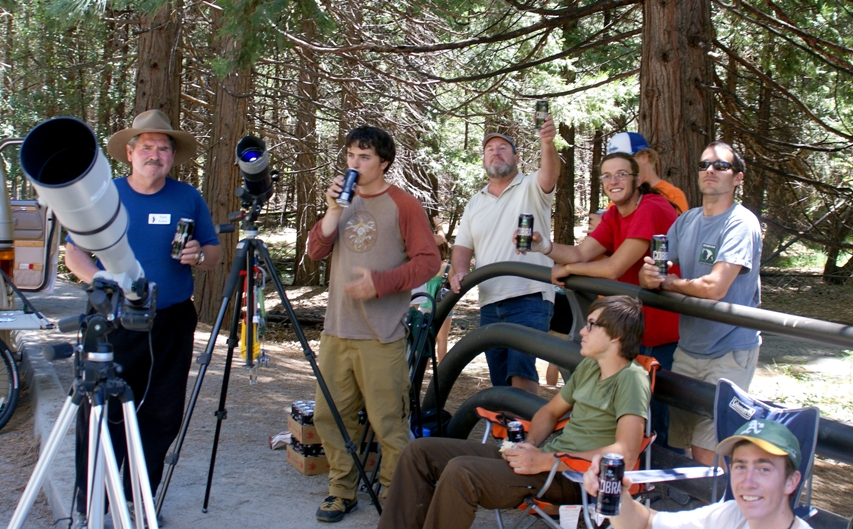
| Tom Evans and the El Cap Bridge crew enjoying tall boys of King Cobra! |
Subscribe to:
Posts (Atom)


 Posts
Posts